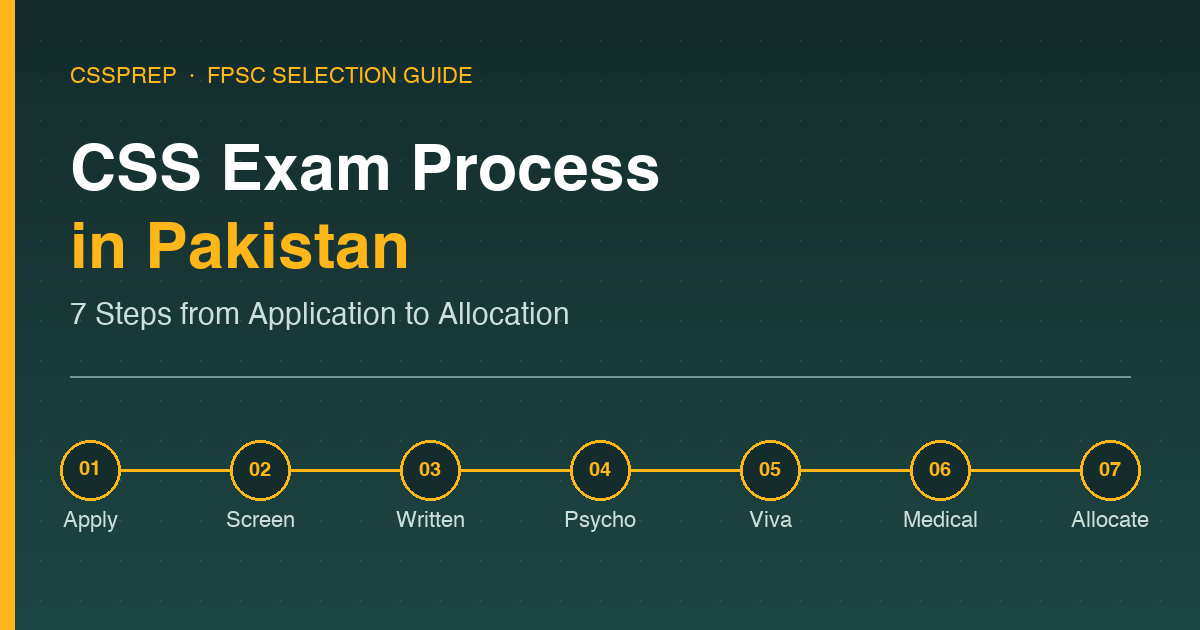
The CSS exam process in Pakistan is a long, multi-stage journey — not a single test. From submitting your application to the Federal Public Service Commission (FPSC) to the day you're allocated to an occupational group, candidates pass through seven distinct stages, each with its own format, purpose, and pass criteria.
This guide breaks down the complete CSS process step by step — application, screening test, written examination, psychological assessment, interview, medical examination, and final allocation — so you know exactly what to expect at every stage of the Central Superior Services selection process. If you haven't already, it's worth starting with the complete guide to the CSS exam in Pakistan for eligibility, syllabus, and preparation strategy before diving into the process itself. See the eligible rules and 2027 dates in full on the companion FPSC guide.
Overview: How Many Stages Does the CSS Process Have?
The CSS exam process in Pakistan consists of seven sequential stages:
- Application and registration
- CSS screening test
- Written examination
- Psychological assessment
- Interview (viva voce)
- Medical examination
- Final merit list and group allocation
Each stage acts as a filter — candidates must clear one before advancing to the next, and the entire process from application to allocation typically spans close to a year.
Step 1: CSS Application and Registration
The CSS process begins when FPSC opens applications through its official online portal, usually announced alongside the year's recruitment notification.
When FPSC opens applications
FPSC publishes the CSS advertisement annually, specifying the application window, number of vacancies across occupational groups, and eligibility criteria for that recruitment cycle.
Selecting optional subjects and group preferences
At the application stage, candidates choose their optional subjects and rank their occupational group preferences — decisions that carry weight later, since group allocation depends on both merit position and these stated preferences.
Documents required
- Educational certificates
- Domicile certificate
- CNIC
- Photographs
- Application fee paid through FPSC's designated channels
Step 2: CSS Screening Test
The CSS screening test is the first real filter in the selection process — this is the MPT (MCQ-Based Preliminary Test).
What is the CSS screening test?
It's an objective-type, MCQ-based qualifying exam designed to reduce a large applicant pool to a manageable number before the written examination. It covers general knowledge, current affairs, and analytical ability.
Format and negative marking
The screening test typically applies negative marking for incorrect answers, which means guesswork carries risk — accuracy matters more than attempting every question.
Does it count toward final merit?
No. The CSS screening test is purely qualifying in nature — candidates either pass and proceed to the written exam, or they don't. Screening test marks are not added to the final merit calculation. Practise with solved MPT past papers to build accuracy under negative marking.
Step 3: CSS Written Examination
The written examination is the core of the entire CSS exam process and carries the heaviest weight in the final merit list.
Compulsory papers
Every candidate attempts a fixed set of compulsory subjects — including English Essay, Precis and Composition, General Science and Ability, Current Affairs, Pakistan Affairs, and Islamic Studies (or Comparative Religion for non-Muslim candidates).
Optional papers
Beyond the compulsory subjects, candidates sit optional papers chosen at the application stage and selected from FPSC's approved subject list. Compare your options with the optional subjects decision guide.
Exam duration and schedule
The CSS written examination is conducted over several consecutive days, with candidates writing multiple descriptive-type papers, each requiring strong time management and structured essay-writing skills.
How marks are calculated
Each paper carries a minimum qualifying percentage, and candidates must clear both individual subject thresholds and an overall aggregate to advance to the next stage of the CSS process. See the current numbers on the CSS exam pattern page.
Step 4: Psychological Assessment
Candidates who clear the written examination move into the psychological assessment stage — a distinguishing feature of the CSS selection process compared to many other competitive exams.
What happens during the evaluation
This stage typically involves aptitude and personality-based assessment tools designed to evaluate temperament, decision-making style, and psychological suitability for a civil service career.
Why FPSC includes this stage
Since CSS officers go on to hold administrative, regulatory, or diplomatic authority, FPSC uses this stage to assess whether a candidate's psychological profile fits the demands of public office — not just their academic knowledge.
Step 5: CSS Interview (Viva Voce)
The interview, or viva voce, is often the most nerve-wracking stage of the CSS exam process — and one of the most decisive.
Who conducts the interview
A panel appointed by FPSC, typically composed of senior officials and subject-matter members, conducts the viva voce.
What the panel evaluates
The interview panel assesses general awareness, communication skills, confidence, decision-making ability, and overall personality — essentially testing whether the candidate is ready to represent the civil service publicly.
How to prepare
Strong interview preparation usually includes mock interviews, staying current on national and international affairs, and being able to speak confidently about one's academic background, optional subjects, and reasons for pursuing a career in Central Superior Services. Refresh your themes with the current affairs desk and Pakistan affairs desk.
Step 6: Medical Examination
Before final selection, shortlisted candidates undergo a medical examination to confirm fitness for civil service duties.
Medical fitness standards
A designated medical board evaluates candidates against standard fitness criteria set by FPSC, covering general health, vision, and other physical requirements relevant to civil service roles.
When it happens in the process
The medical examination typically takes place after the interview stage, closer to the final stages of the CSS process, once a candidate's provisional merit position is already known.
Step 7: Final Merit List and Group Allocation
The last step in the CSS exam process is where all previous stages come together.
How FPSC compiles the final merit list
FPSC combines scores from the written examination, psychological assessment, and interview to generate the final merit list — the definitive ranking that determines each candidate's outcome.
How group allocation works
Occupational group allocation is based on a combination of merit position and the group preferences submitted at the application stage. Higher-ranked candidates generally get first access to competitive groups such as the Foreign Service of Pakistan, District Management Group, and Police Service of Pakistan.
What happens after allocation
Selected candidates proceed to mandatory training at the relevant civil service academy before being posted to their allocated department, marking the formal start of their career as a CSS officer. See what that career looks like on the CSS officer guide and the salary & perks desk.
CSS Process Timeline: How Long Does It Take?
The complete CSS exam process — from application submission to final allocation — generally spans close to a year, sometimes longer depending on FPSC's scheduling for that recruitment cycle. Roughly:
- Application and screening test: early stage of the cycle.
- Written examination: several months after screening.
- Result, psychological assessment, and interview: following the written exam results.
- Medical examination and final allocation: closing stage of the process.
Because exact dates shift every year, candidates should always follow FPSC's official CSS timeline notification rather than relying on previous years' schedules.
Common Reasons Candidates Get Stuck at Each Stage
| Stage | Where candidates typically struggle |
|---|---|
| Screening test | Weak general knowledge base or poor time management under negative marking. |
| Written examination | Underprepared essay and precis writing, and inconsistent subject-wise scoring. |
| Psychological assessment | Lack of awareness about what the stage evaluates, leading to unnecessary anxiety. |
| Interview | Weak communication skills or shallow knowledge of current affairs and chosen optional subjects. |
| Medical examination | Overlooked fitness requirements not addressed in advance. |
Conclusion
The CSS exam process in Pakistan is a demanding, multi-stage journey — application, screening test, written examination, psychological assessment, interview, medical examination, and final allocation — but understanding each step in advance makes it far less overwhelming. Preparation isn't just about subject knowledge; it's about knowing exactly what each stage of the Central Superior Services selection process demands and preparing accordingly.
For eligibility criteria, exam pattern, and syllabus details, revisit the complete CSS exam guide — and always confirm current-year dates and requirements directly through FPSC's official notifications before applying.
Continue your CSS preparation
Frequently asked questions about the CSS exam process
Application and registration, screening test, written examination, psychological assessment, interview, medical examination, and final merit-based allocation — seven stages in total.
The CSS exam process in Pakistan has seven main stages, from application submission to occupational group allocation.
No. The screening test is a qualifying stage only and does not contribute to the final merit list.
After the interview, candidates proceed to the medical examination, followed by compilation of the final merit list and group allocation.
The full CSS process typically takes close to a year, though exact timelines vary according to FPSC's annual schedule.
Candidates state group preferences at the application stage, but final allocation depends on merit position combined with those preferences — higher merit gives access to more competitive groups.
Yes. The CSS screening test is the MCQ-based preliminary test (MPT) that filters the applicant pool before the written examination. It is qualifying only and its marks are not added to final merit.
It is a separating stage informed by written exercises and group activities; FPSC combines written, psychological, and interview scores into the final merit list, so performance at this stage matters for overall outcome.